

When the Game Is Rigged and You Don’t Even Know You’re Playing
Let’s be real: if you’re a young Black man in America, you didn’t get a fair start.
You were born into a game that was designed long before you ever took your first breath—a game with rules you were never taught, penalties you never agreed to, and traps placed exactly where you’re most likely to step.
There are pitfalls everywhere.
They look like “normal life”:
- Schools that expect you to fail more than they expect you to lead.
- Neighborhoods starved of resources but flooded with temptation.
- A justice system that watches you harder and forgives you less.
- Media that shows you mostly as a threat, a joke, or a statistic—rarely as a builder, thinker, or protector.
Because we don’t always see the design, we fall prey to it.
What feels like “just the way it is” is often on purpose.
That’s the sinister part. It goes deeper than we can imagine. And when we don’t understand what’s really going on, we start punishing the person closest to us: ourselves. Then our families. Then each other.
This blog is a straight conversation with you, from someone who loves you enough to tell the truth:
- Yes, there are systems designed to keep you down.
- There are also traps you can’t always see.
- And despite all of that, you still have power—more than you think—to break cycles and build something different.
I’m going to share three profound ways to do that—moves you can learn, live, and teach to other brothers coming behind you.
The Hidden Design: Why It Feels Like Everything Is Against You
When you grow up always fighting—teachers, police, parents, bills, your own mind—it can feel like
you are the problem.
But think about this:
If we see the same patterns in millions of Black boys and men…
- Over-policing.
- Underfunded schools.
- Harsher punishments.
- Fewer second chances.
- Constant messages that we’re dangerous, lazy, or disposable.
…that’s not random. That’s design.
You are not broken.
The system is designed to make it harder for you to win.
But here’s where it gets complicated:
- When the system hurts us long enough, we start to help it do its job.
- We turn angry at ourselves, our brothers, our women, our kids.
- We numb out with substances, distractions, and drama.
- Sometimes we settle for survival instead of planning for a future.
And in the process, we often punish ourselves with:
- Self-hate and shame.
- Explosive anger and violence toward one another.
- Abandonment of our responsibilities and relationships.
And we punish our families by:
- Leaving them emotionally or physically.
- Passing on fear, insecurity, and unresolved trauma.
- Repeating the same cycles of neglect we suffered.
It’s painful to say, but we need to be honest:
There is a design to destroy our community—but we are not powerless pieces.
We can re-learn the game.
You have the power to rebuild our sense of self.
Together, we can design systems that push back.
Here’s how.
Way #1: Learn the Game So You Can Beat the Game
You cannot dodge a trap you refuse to see.
The first way to break negative cycles is to study the game you’re in:
- Study how laws work in your city and state.
- Study how credit, debt, and money really function.
- Study how the school-to-prison pipeline shows up where you live.
- Study how the media shapes the way you see yourself and other brothers.
This isn’t about becoming paranoid. It’s about becoming aware.
When you learn the game:
- That cop stopping you is no longer just a moment—it’s part of a bigger pattern.
- That school suspension is not just “you messing up,” but also about systems that don’t make space for your brilliance or your pain.
- That job rejection might be biased, and instead of quitting, you learn how to outprepare, out-network, and outlast.
How to practice this in your own life:
- Read one book or watch one documentary about Black history, mass incarceration, or financial literacy every month.
- Ask older men you trust about their mistakes and what they wish they’d known at your age.
- Pay attention to patterns in your own life: Where do you keep tripping? Who benefits when you stay stuck?
How to teach this to others:
- Start a “Game Study” circle with a few friends: pick a topic (money, law, relationships, mental health) and take turns bringing one thing you learned that week.
- Share clips, articles, and books with younger brothers, cousins, or teammates and ask, “What do you see in this? What does this look like in our neighborhood?”
- Bring these conversations into barbershops, group chats, and car rides. Make awareness normal, not weird.
The goal is not to obsess over the system. The goal is to understand it well enough to navigate it, challenge it, and eventually redesign it.
Way #2: Rebuild Your Identity from the Inside Out
When a system has been telling you for generations that you are a problem, a threat, or a burden, it gets inside.
You start believing things like:
- “I’m just not meant to be successful.”
- “I’m not smart like them.”
- “I’m not the type to be a husband or a father.”
- “Only athletes, rappers, or brothers who know the hood win where I’m from.”
That’s not just a lie. It’s a weapon dropped in your mind.
Breaking the cycle means doing deep work on your identity: Who are you outside of what they told you?
You are so much more than what the system tells you:
- A thinker.
- A creator.
- A protector.
- A builder.
- A man capable of love, leadership, and legacy.
But you won’t feel that just because I type it. You have to do the work to rebuild that from the inside.
How to practice this in your own life:
- Talk to someone about your pain. That could be a therapist, mentor, elder, or trusted friend. Silence is one of the system’s favorite tools.
- Write down your story—not just your worst moments. Include your wins, your resilience, the times you got back up. Your story proves you’re more than your mistakes.
- Challenge your self-talk. When you hear, “I’m a failure,” respond with, “No, I failed at something—but I’m still growing.”
How to teach this to others:
- Speak life into younger brothers: tell them what you see in them that they might not see in themselves yet.
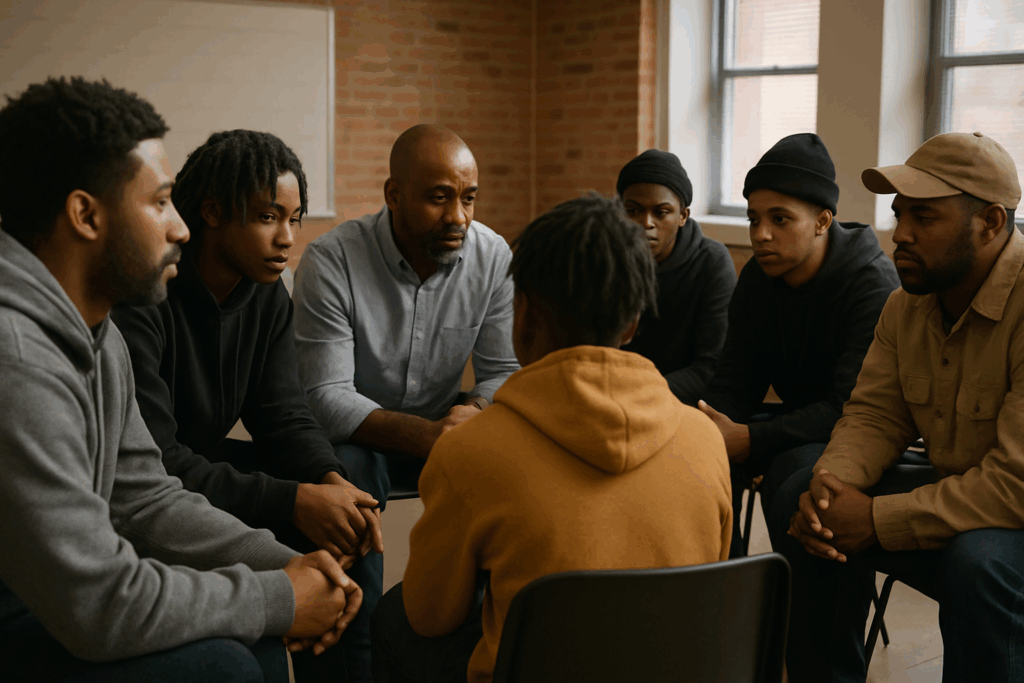
- Create spaces where Black men can be honest without being clowned—small groups where we can talk about fear, grief, and dreams.
- Model humility and growth. Show them that being a man is not about pretending to be perfect; it’s about owning your truth and working on it.
When you rebuild your identity, you break one of the deepest weapons of the system: internalized hate.
You become a man who doesn’t have to punish himself or his family to prove he’s strong.
Way #3: Build Micro-Systems of Hope and Accountability
If the big system wasn’t built for us, we need to build micro-systems that are.
A system is just a structure that makes certain outcomes more likely.
Right now, many of our surroundings are set up to make:
- Jail more likely than graduation.
- Arguments more likely than conversations.
- Survival more likely than success.
We can’t change everything overnight—but we can build small systems in our daily lives that push in the opposite direction.
Micro-systems look like:
- A weekly check-in with 2–3 brothers where you talk goals, setbacks, and next steps.
- A family rule that there will be no disrespect or threats in conflict—only taking a break and coming back when cooler heads can talk.
- A commitment that if one of your boys is drunk and ready to fight, another one steps in as the “designated peacemaker” to get him home.
- A consistent habit of reading, working out, praying/meditating, or practicing your craft every day at the same time.
These small structures create a different pattern over time.
How to practice this in your own life:
- Pick one area you want to change (money, anger, relationships, school/work) and design a small system for it. For example:
Money: automatic savings, no major purchase without 24 hours of thought.
Anger: when I feel myself about to explode, I step away, drink water, and text one person I trust. - Ask one or two friends to be your accountability partners—people who can call you out in love when you drift.
How to teach this to others:
- Show younger brothers your systems. Don’t just say “stay out of trouble”—show them how you stay out of trouble.
- Help your family create simple agreements: weekly dinners, tech-free time, or regular check-ins with your kids.
- Bring structure into spaces you influence—teams, jobsites, churches, classrooms. Introduce routines that build respect, growth, and safety.
When we build micro-systems that protect hope and demand accountability, we’re no longer just reacting to what was built against us—we’re constructing something for us.
You Are Not the Problem—But You Are the Builder
The reality is daunting.
Yes, there is a structured plight designed to break our communities. Yes, there are layers of issues disguised as “just life” that are actually engineered to keep you small, angry, distracted, and defeated.
But here’s the reality I need you to hear:
You are not broken.
What you’re facing is a system designed to make winning harder.
And you are far more than the circumstances stacked against you.
You are a builder.
You can:
1. Learn the game so you can beat it.
2. Rebuild your identity from the inside out.
3. Create micro-systems of hope and accountability that change your life—and the lives around you.
And when you learn these moves, they are not just for you. They are for your sons, your nephews, your students, your teammates, your brothers in the neighborhood.
The system was designed to multiply damage.
We can design ourselves to multiply healing, courage, and vision.
You may not have chosen the battlefield.
But you can choose how you stand on it.
And you can choose what you build on top of the rubble they hoped would bury you.
The next generation is watching.
Let’s give them something different to inherit.


