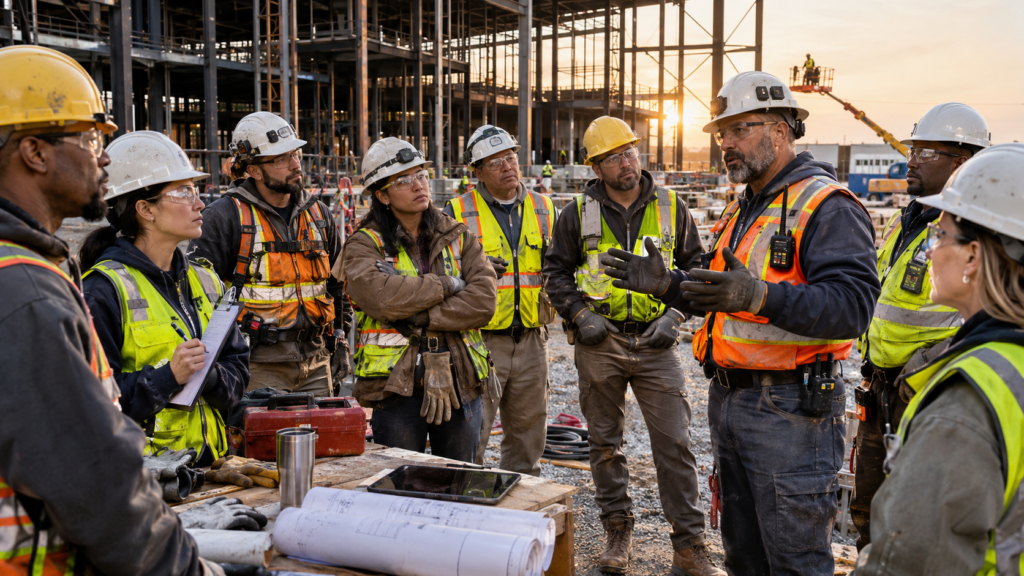

Most crews already have a daily huddle in construction. The problem is what happens in it.
Somebody reads the safety topic off a sheet. The foreman talks for twenty minutes. Half the crew is looking at their phones. Then everybody walks off and does what they planned anyway.
That’s not a huddle. That’s a lecture with coffee.
A good huddle takes ten minutes. It’s where problems show up before they cost you.
Why the daily huddle matters more than the schedule
The schedule tells you what’s supposed to happen. The huddle tells you what’s actually going to happen.
The schedule doesn’t know the lift is down. It doesn’t know the inspector moved to Thursday, or that the drywall crew is two days behind on the floor you need. Your crew knows. They just need a place to say it.
That’s what Lean Construction taught me. The people closest to the work see the problems first. Your job as a foreman is to make it easy for them to speak up, every single morning. It’s one more reason foremen need leadership training, not just field experience.
It took me almost 20 years in this industry before I saw a daily huddle done well. It was on a large hospital project in San Francisco.
It worked because the team was aligned. Everyone knew what needed to happen that day, what constraints existed, what each person needed to get their work done, and what the overall goals for the day were.
That huddle promoted real collaboration. And everyone understood why it mattered. Each player on the crew needed the others to have a successful day.
Keep it short, standing and on time
Same time. Same place. Every day.
Start at the gang box or the plan table, not in the trailer. Everybody stands.
If you say 6:30, start at 6:30. If you wait for whoever’s late, you just taught the whole crew that 6:30 means 6:40.
Ten minutes. When the huddle runs long, people stop listening. And the next day, they stop talking.
A simple daily huddle agenda for construction crews
You need the same four questions, in the same order, every day.
- Safety first. What’s the hazard today, on this work, in this area? The open edge on level three. The new hire running the scissor lift for the first time.
- What did we promise yesterday, and did we get it done? Go person by person. Yes or no. If it’s no, ask why, without blame.
- What are we committing to today? Each person says what they’ll finish by the end of the shift. Their words, not yours.
- What’s in the way? Material, information, another trade, equipment, a question for the engineer. Write it down. Somebody owns getting it cleared.
Let the crew do the talking
A lot of foremen run the huddle like a briefing. They talk, the crew listens.
Flip it.
Your job is to ask questions and listen. Let the second-year apprentice tell you what she needs to finish the rough-in. Let the journeyman with thirty years in the trade tell you the layout doesn’t match the field.
If only the loudest people talk, you’ll only hear the loudest problems. Go around the circle. Make room for the quiet ones. Some of your best people won’t speak up until they know it’s safe to.
When someone raises a problem, thank them. Especially if it’s bad news.
The first time you snap at someone for bringing you a problem is the last time they bring you one early. That’s a big part of what good field leadership looks like on a real jobsite.
Promises are the real product of the huddle
In Lean we talk about reliable promises. It sounds technical. It isn’t.
It means when you say you’ll do something, you do it. When you can’t, you say so early.
The huddle is where those promises get made out loud, in front of the crew. People take a promise more seriously when their teammates heard them make it.
Over a few weeks, you find out who you can count on, where the work keeps getting stuck, and which roadblocks keep coming back. It’s how you build leaders, not just schedules.
It also builds trust. Not because you gave a speech about trust, but because people watched each other keep their word, day after day.
One example I’ll never forget started out not so great.
A journeyman damaged some framing on the site with his scissor lift. No one was around to see it.
He could have left and kept working. Instead, he reported it to our general foreman.
At one of our weekly project safety meetings, in front of the entire site, over 500 people, he was recognized for how he handled it. It reinforced what the team expected of each other, and how much trust matters.
He was awarded a flat-screen TV for his honesty.
What to do when the huddle goes sideways
Some days it will.
Don’t solve it in the huddle. Say, “Good point. You, me and the electrical foreman, right after this.” Then actually follow up.
The huddle surfaces problems. It doesn’t have to solve them all.
Common questions
How long should a daily huddle in construction take?
About ten minutes. That’s long enough to cover safety, yesterday’s promises, today’s commitments and roadblocks. Anything that needs more time gets its own conversation right after.
Who should run the daily huddle?
The foreman runs it, but the crew does most of the talking. The foreman asks questions, listens and makes sure every roadblock has an owner.
Three things to try this week
- Pick a time and a spot, and start on the minute every day this week.
- Use the four questions: safety, yesterday’s promises, today’s commitments, roadblocks. Write the roadblocks down.
- Talk less. Count how many people besides you speak in each huddle, and try to get everyone talking by Friday.
A daily huddle won’t fix everything on your job. But it will show you what’s broken while there’s still time to fix it.
If you want help building this habit across your foremen, see how I work with field teams on my leadership training services page.
Keep reading
- What Good Field Leadership Looks Like on a Real Jobsite
- Why Foremen Need Leadership Training, Not Just Field Experience
- Field Leadership Development: Build Leaders, Not Just Schedules
Training a group of apprentices or new foremen? See the Seven Principles workbooks and program licenses.
About Henry Nutt III: Henry rose from sheet metal apprentice to construction executive over nearly 40 years. He is a National Academy of Construction inductee, AGC of California Vice President, Governor-appointed CSLB Board Member, American Heart Association Board Member, and former Lean Construction Institute National Board Chair and Pioneer Award recipient. He is the author of Seven Principles: Creating Your Success in the Construction Industry.


