
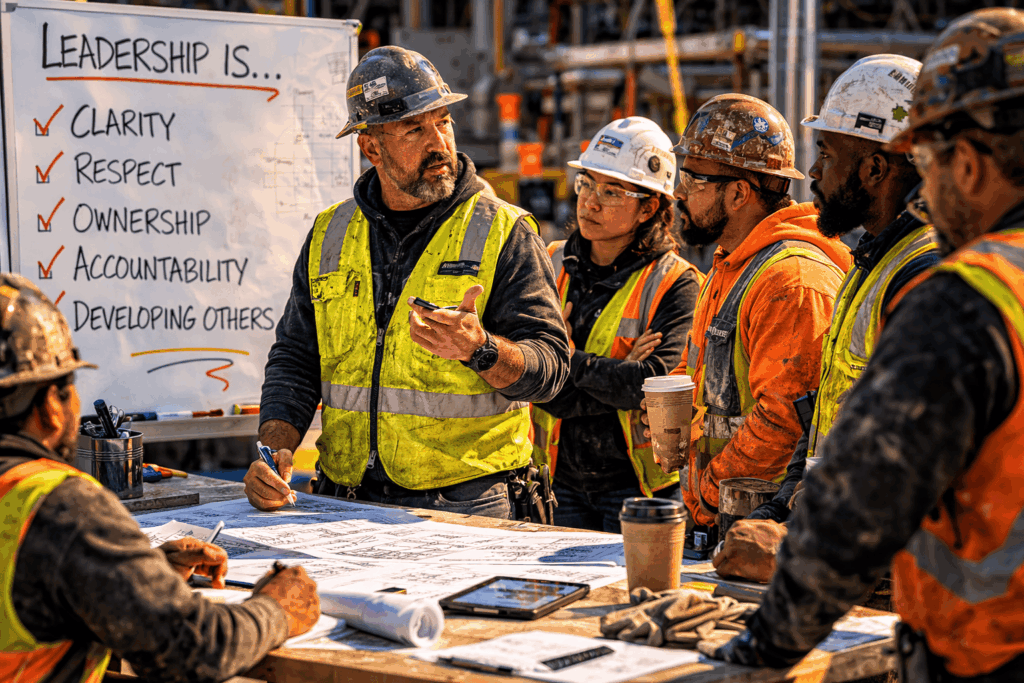

Everybody says they want better field leaders.
But on real jobsites, we often do very little to truly develop them.
We promote a good mechanic. We hand them more responsibility. We expect them to run the work, manage people, communicate with office staff, solve problems, deal with conflict, stay on schedule, maintain quality, and somehow keep morale up while pressure comes from every direction. Then, when they struggle, we call it a people problem, an attitude problem, or a lack of readiness.
That is not leadership development. That is exposure without support.
Real field leadership development is not a slogan, a one-time class, or a laminated card with company values printed on it. It is a practical, daily process that helps people grow while the work is happening. It is built in the middle of production, not outside of it. And if we are serious about building stronger teams, better culture, and more consistent project outcomes, then we have to stop pretending that leadership magically appears once someone gets a title.
On a real jobsite, field leadership development starts with one hard truth: being technically strong does not automatically make someone ready to lead people.
A person can perform work at a high level and still struggle to give clear direction. They can understand the drawings and still fail to build trust. They can know means and methods and still create confusion, tension, and rework because they do not know how to communicate under pressure. Leadership in the field is not just about getting the work done. It is about how the work gets done, how people are treated while doing it, and whether the team is getting stronger or weaker because of that leader’s presence.
That means real development must focus on behaviors, not just results.
- Can this person run a huddle that creates clarity?
- Can they correct someone without disrespecting them?
- Can they think ahead instead of reacting late?
- Can they hold standards without humiliating people?
- Can they coordinate with other trades, ask better questions, and stay steady when things go sideways?
That is field leadership.
And it does not get built by accident.
On a real jobsite, leadership development looks like a superintendent, foreperson, general foreperson, or senior leader taking time to explain not just what needs to happen, but why. It looks like real-time coaching. It looks like pulling someone aside after a rough interaction and saying, “You were right about the issue, but your delivery shut that person down.” It looks like helping someone prepare for tomorrow’s work, rather than only criticizing them after today goes badly.
It also looks like repetition.
Most field leaders do not need more theory. They need guided reps.
- They need chances to lead the morning huddle.
- They need support in running coordination conversations.
- They need help learning how to plan work in a way the crew can actually follow.
- They need opportunities to make decisions, reflect on them, and improve without feeling that one mistake makes them unfit to lead.
That is how confidence gets built the right way.
Not false confidence.
Not loud confidence.
Not ego.
Real confidence.
The kind that comes from being sharpened, corrected, trusted, and developed over time.
Too many jobsites still operate with an outdated model. We let people sink or swim. We confuse toughness with preparation. We assume pressure will make people better. Sometimes, pressure reveals people. But by itself, pressure does not develop people. In many cases, it just exposes where the system has failed them.
If your field leader is constantly frustrated, short-tempered with people, disorganized, reactive, and overwhelmed, that may not just be about them. That may be because nobody ever really taught them how to lead under real-world conditions.
And that matters, because weak field leadership affects everything.
- It affects safety because people stop speaking up.
- It affects quality because details get rushed and missed.
- It affects the schedule because confusion creates rework.
- It affects retention because good people get tired of chaos and disrespect.
- It affects culture because crews become guarded, cynical, and disconnected.
We talk a lot in construction about productivity. But leadership development is productivity. Respect is productivity. Clear communication is productivity. Accountability done well is productivity. A calm, prepared field leader can change the tone, rhythm, and performance of an entire jobsite.
So what does effective field leadership development actually look like?
- It looks like identifying potential early, not just waiting until there is an opening.
- It looks like defining what good field leadership means in practical language.
- It looks like giving emerging leaders small areas of ownership before giving them full responsibility.
- It looks like regular check-ins that go beyond the workforce and production numbers.
- It looks like honest, specific, and useful feedback.
- It looks like teaching people how to think, not just what to do.
- It looks like making room for questions without labeling curiosity as weakness.
- It looks like helping leaders understand that production and people are not competing priorities. Great leaders learn how to deliver both.
It also looks like modeling.
- You cannot develop respectful field leaders in a disrespectful environment.
- You cannot expect emotional control from people who only see emotional volatility above them.
- You cannot preach accountability and then lead with inconsistency, favoritism, and poor communication.
People learn leadership by watching leadership.
That is why every company needs to ask itself a serious question: are we developing field leaders, or are we just demanding more from them?
There is a difference.
- Development requires patience.
- Demand only requires expectation.
And one of the biggest mistakes we make is assuming that everyone develops the same way. Some field leaders need help with confidence. Some need help with planning. Some need help with communication. Some need help unlearning habits they picked up in harsh environments where yelling, sarcasm, and public embarrassment were treated as normal tools of supervision. If we want a different future, we have to be willing to build leaders differently than many of us were built.
That does not mean lowering standards. It means raising the quality of leadership.
The best field leaders I have seen are not always the loudest people. They are often the steadiest. They create clarity. They keep their word. They know the work. They respect people. They handle problems early. They do not panic in front of the crew. They do not need to dominate every conversation to maintain control. Their presence creates confidence because people know where they stand.
That kind of leader is not just good for the jobsite. They are good for the industry.
And if we are serious about the future of construction, then field leadership development cannot be treated like an extra. It has to be part of the work. Part of the plan. Part of the culture. Part of how we measure success.
Because here is the truth: a company can have strong branding, polished values, and great recruiting language, but if the field experience is inconsistent, confusing, or toxic, people will eventually see through it.
The real test of leadership development is not what is written in a training manual.
- It is what a new worker experiences on a Tuesday morning.
- It is how a foreperson handles a mistake.
- It is whether people leave a conversation clearer or more discouraged.
- It is whether leaders are building more leaders or just creating dependence.
- It is whether the jobsite feels like a place where people can grow, contribute, and become better.
That is what field leadership development looks like on a real jobsite.
- It is practical.
- It is human.
- It is intentional.
- It is visible.
And when done right, it changes more than project outcomes.
It changes people.
What Works
Clear expectations.
Field leaders need practical definitions of what good leadership looks like, not vague language.
Coaching in real time.
Quick corrections, direct feedback, and immediate teaching moments help leaders improve faster.
Small leadership reps.
Let emerging leaders run huddles, own small scopes, and lead conversations before giving them full control.
Respectful accountability.
People grow more when standards are high, and dignity stays intact.
Consistent mentoring.
Development happens faster when experienced leaders intentionally invest in others.
Reflection after action.
A few minutes spent asking what went well, what missed, and what needs to change builds maturity.
Modeling the right behavior.
Leaders above the field set the tone. What they tolerate and demonstrate gets repeated.
What Doesn’t
Promoting people without preparing them.
A title without development creates stress, inconsistency, and frustration.
Leading only through pressure.
Pressure may expose weakness, but it does not automatically build leadership skill.
Public embarrassment.
Yelling, sarcasm, and blame damage trust and usually reduce performance over time.
Vague feedback.
Telling someone to “step up” or “be better” is not coaching.
Ignoring people skills.
Technical ability matters, but poor communication and poor treatment of people will hurt the job.
One-time training with no follow-up.
Leadership is not built in a single session. It takes repetition and reinforcement.
Assuming experience equals leadership.
Years in the trade do not automatically produce self-awareness, discipline, or influence.


